

I have a lot of things I want to do.
And I mean a lot.
Things I want to write, build, learn, change, and figure out. Ideas for my business. Projects around the house. And, of course, the occasional brilliant idea that shows up while I’m supposed to be working on something else.
My eyes have always been bigger than my stomach. Except instead of food, it’s ideas and projects.
These days, it’s easier than ever to convince yourself that everything is within reach. I’m a bit of a systems nerd. Give me a clever framework, a new tool, or a better way to organize a messy project, and I’m interested. Add AI to the mix, and suddenly it feels like an entire project is one fancy prompt away.
Sometimes those tools make things much easier.
But then there’s actual life.
The meetings. The emails. The interruptions. The energy you thought you’d have but don’t. And that project you imagined knocking out in an afternoon? Turns out, there’s a whole lot more involved than you thought.
I’ve had to learn a very sophisticated lesson from this, over and over again:
Stuff is harder than it looks.
I know. Groundbreaking stuff.
And then there are the days when I’ve been working my ass off. Thinking, writing, organizing, answering messages, making decisions, jumping between a dozen things.
By the end of the day, I’m wondering: What the hell did I actually do today?
I was busy. I was trying. So why does it feel like I’m getting nowhere?
There’s a certain irony here. I’m a neurodivergent life coach. Helping people move from knowing what they want to do to actually doing it is literally my job. And I still wrestle with this stuff myself.
But through my experience, coaching work, and a fair amount of learning and experimenting, I’ve come to understand something useful:
Doing the work is only part of getting it done.

Getting things done involves five kinds of work
Think about something you’ve been wanting to do. Maybe it’s updating your résumé, getting your finances organized, making a change at work, or tackling a project you’ve been putting off.
You know you want to do it. You might even know how. But somewhere between the idea and the result, things get complicated.
When we lump all of that together under I need to get this done, it’s hard to see what’s happening or where we need help.
In my coaching work, I use a five-part model to make those differences easier to understand:
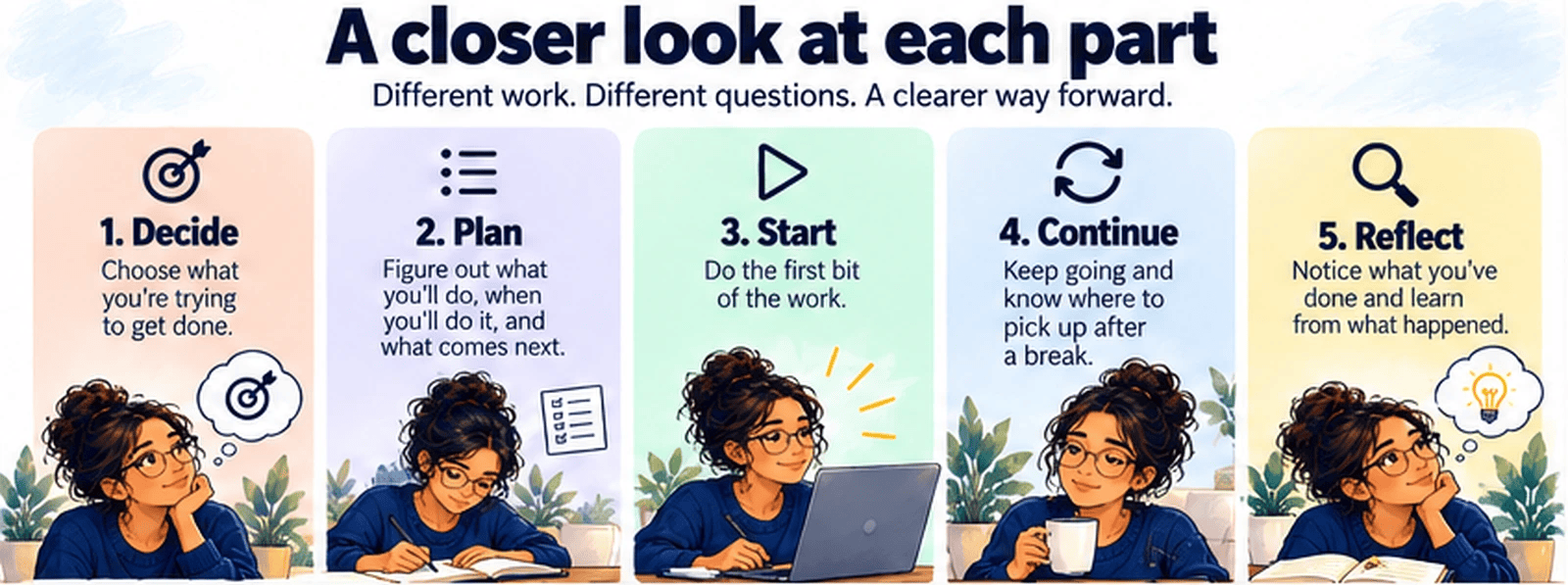
- Decide: Choose what you’re trying to get done.
- Plan: Figure out what you’ll do, when you’ll do it, and what comes next.
- Start: Do the first bit of the work.
- Continue: Keep going, and know where to pick up after a break.
- Reflect: Notice what you’ve done, give yourself credit, and learn from what happened.
Yes, I know. Another framework. From the guy who just admitted he’s a systems nerd.
And these words might sound almost ridiculously obvious.
Decide? Plan? Start? Thanks, Kevin. Never would have thought of that.
But each part involves different work. Understanding the difference helps us see what deserves attention when things aren’t going well.
One more thing: this is a loop, not a straight line.
Which is why, despite putting Decide first, I’m going to start with Reflect.
I know. Already breaking my own model.
Bear with me.
Reflect: Look at what’s already happened
Before deciding what to do next, it helps to understand what’s happened so far.
That’s reflection. And I don’t mean an elaborate journaling session or personal performance review.
I mean taking a moment to notice your experience.
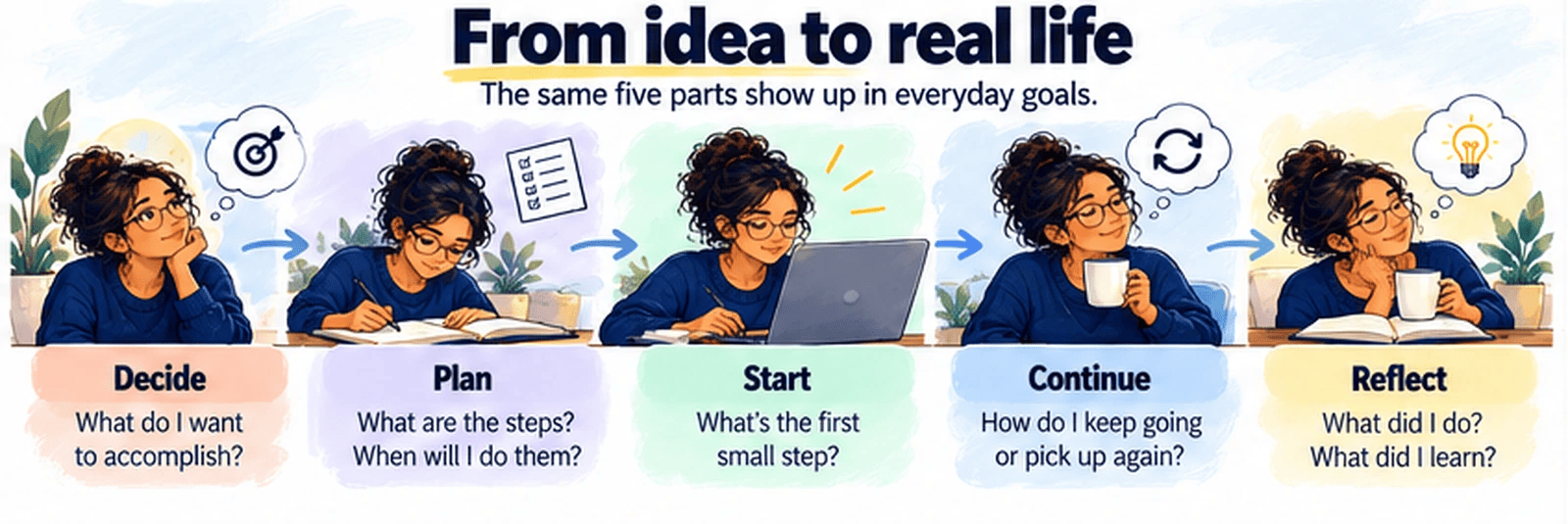
What did I actually do?
Take updating your résumé, for example.
You might tell yourself, I haven’t made any progress. But looking back, you realize you’ve found your old résumé, collected a few job descriptions, and remembered projects you want to include.
That’s progress worth recognizing.
You also notice that every time you sit down, you get overwhelmed trying to rewrite the entire thing at once. Now you’ve learned something useful.
In coaching, I like to begin here. Before making another plan, I want to understand what someone has tried, what got difficult, and what they’ve accomplished.
Looking back gives us information for choosing what comes next.

Decide: Choose what you’re trying to get done
Deciding means choosing something specific to work toward.
There’s a difference between having something on your mind and knowing what you’re trying to accomplish.
I really need to get my career figured out.
I understand that feeling. But what does “figured out” mean? Are you trying to decide whether to leave your job, explore another career, update your résumé, or apply for a particular position?
Those are different outcomes.
A decision gives you something to aim for.
For example: I’m going to update my résumé so I can apply for this position.
Now you know what you’re working toward and what would count as getting it done.
Without that choice, you could spend hours browsing job postings or collecting information without moving toward the result you wanted. Deciding what can wait matters, too, especially when several things compete for your attention.
You can change your decision when you learn something new. But for now, you have a direction.
The next question is how to get there.
Plan: Figure out how you’ll get there
Planning means working out what needs to happen, what order makes sense, and when you’ll have time to do it.
Here’s a distinction that gets lost:
A to-do list isn’t automatically a plan.
Neither is a calendar, a project management app, or a beautifully organized project board. Those tools help you remember and manage work. Planning is figuring out what belongs in them.
Back to the résumé. Perhaps you’ll find the latest version, review the job description, update your experience, check the formatting, and set aside time to finish.
You’ll also want a rough idea of how long each part might take.
That’s planning.
A plan gives you a way to approach the work.
When it’s working, you can see the steps between where you are and where you’re trying to go. When it isn’t, the project feels like one enormous blob.
You sit down to “work on your résumé” and immediately have to figure out what that means.
For something small, a plan might be one sentence. A bigger project may need several steps, time estimates, and help from other people.
And yes, sometimes you can wing it. That works for plenty of familiar tasks. But when something is complicated, a rough plan means you don’t have to figure everything out while you’re trying to do it.
Of course, a plan has one important limitation.
It doesn’t do the work for you.
Start: Do the first bit of the work
Starting is the moment you move from intending to do something into doing it.
You can decide, plan, set reminders, and organize an entire workspace without beginning the work itself.
(I say this as someone who genuinely enjoys setting up systems.)
Starting means taking a real action on the thing you’re trying to accomplish.
For your résumé, that might mean rewriting the first experience bullet. You’ve changed something. The work has begun.
But knowing the first step and taking it are different experiences.
For many people with ADHD, task initiation is difficult. You might know exactly what needs to happen and still struggle to begin.
The task might feel too big. Expectations might be unclear. You might be exhausted, anxious, or worried about getting it wrong.
That’s why, in coaching, I don’t stop at “just start.” I want to understand what’s making that first action difficult.
What would help me take the first step?
Maybe it’s a smaller starting point, a quieter space, clearer instructions, or someone working alongside you.
The answer depends on what’s happening. And once you’ve started, there’s another kind of work ahead.
Continue: Keep going and find your way back
I wish every project happened in one beautiful, uninterrupted stretch.
You sit down, get started, everything makes sense, and you finish. Maybe there’s even a little celebratory music.
Unfortunately, life has other plans.
A meeting starts. Someone needs your attention. You run out of energy. When you return, there’s a new problem:
Where the heck was I?
Continuing means keeping track of where you are so you can keep working or pick up again after a break.
That includes doing the next part, remembering what’s finished, and adjusting when the plan changes.
Let’s say you’ve updated half your résumé before something pulls you away. A short note might be enough:
Updated work history. Next: revise skills section.
Now you have a place to begin when you return.
That’s why people use checklists, reminders, and project boards. They help us remember what’s done and what comes next.
But the tool isn’t the goal. The goal is to stay connected to the work, even when you can’t do it all at once.
Continuing doesn’t mean pushing indefinitely, either. You can pause, ask for help, change your approach, or recognize that the work no longer makes sense to pursue.
Which brings us back to where we started.
Reflect again: Recognize progress and learn from it
Imagine you’ve spent a few days working on that résumé. Perhaps you’ve finished and submitted the application. Or you’re halfway through.
Either way, take a moment to look back.
What did I actually do? What worked? What was harder than I expected?
And just as importantly: What deserves some credit?
When you’re looking ahead at everything still waiting for you, it’s easy to miss what you’ve accomplished.
Maybe you made a difficult decision, figured out a confusing problem, began something you’d been avoiding, or returned to a project after a tough week.
Those things count, even when the whole project isn’t finished.
Reflection also helps you learn. Perhaps the plan was too ambitious. Working alongside someone made starting easier. Or leaving a note saved you twenty minutes the next morning.
You can use what you notice to keep going, change course, call the work finished, hand it off, or let it go.
And what you learn informs your next decision.
See the loop?
Understanding the work changes how we approach it
When someone tells me they’re struggling to get something done, I don’t want to assume they need more discipline, a better planner, or another productivity app.
I want to understand what’s happening.
Maybe they have too many competing priorities. Maybe the goal is clear but the steps aren’t. Maybe they know the steps but can’t begin, or they keep losing their place after interruptions.
Or maybe they’ve made progress but can’t see it.
From the inside, all of these can sound like: I’m stuck. I’m behind. I can’t get anything done.
But they involve different parts of the work, and they call for different kinds of help.
Of course, the model doesn’t explain everything. If you’re exhausted, overwhelmed, or facing demands that exceed your capacity, you may need rest, support, or a change in your circumstances. Another plan won’t fix that.
The five parts help us see the work more clearly before jumping to a solution.
Making progress you can actually see
I still get excited about too many ideas. I still underestimate how long things will take. And yes, I occasionally spend more time organizing a project than working on it.
But this model helps me see what getting something done actually involves:
- Decide: Choose the outcome you’re working toward.
- Plan: Work out the steps, timing, and what comes next.
- Start: Take the first real action.
- Continue: Keep moving or find your place after a break.
- Reflect: Recognize what happened, give yourself credit, and learn from it.
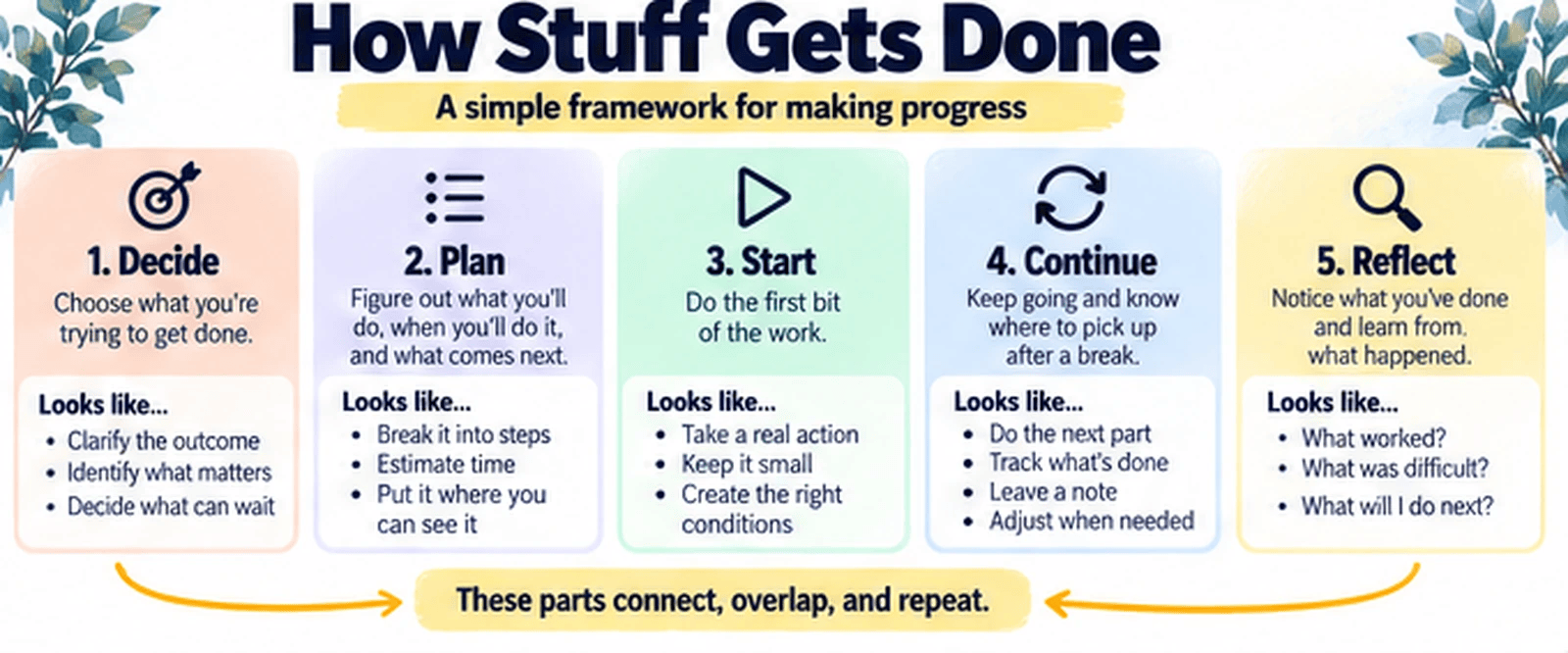
These parts overlap and repeat. You might revisit a decision, change your plan, or reflect halfway through a project. There’s no perfect sequence to follow.
And meaningful progress doesn’t always look like a finished task. Sometimes it’s choosing a direction, finding a way forward, starting something difficult, or coming back after an interruption.
Doing the work is only part of getting it done.
For now, I hope this gives you a clearer picture of how something moves from an idea into the real world.
In an upcoming article, I’ll explore what happens when these parts get stuck. Why can we know what we want and still struggle to decide, plan, start, or continue? And how can we figure out where the trouble begins?
Because seeing the parts is useful. Understanding where things get difficult is the next conversation.