

By the time someone comes to me for coaching, they’ve often already tried a lot.
They’ve learned about ADHD or autism, experimented with planners, and built routines. Some worked beautifully for a while. Then life changed, or keeping the system going became another chore.
And now they’re tired. Really tired.
Sometimes I can almost hear the question underneath our conversation: Kevin, is there something I’m missing?
Some insight, tool, or strategy that will finally make everything easier.
Believe me, I understand the appeal. And if I knew one magical solution that made all of this easier, I’d happily put it on the front page of my website.
Of course, understanding how your brain works matters. Good tools and useful strategies matter, too. I use plenty of both myself.
But there’s a question I think is worth asking before we go looking for another solution.
What do we actually mean when we say we want things to be easier?
Do we want to get more done? Spend less time struggling with everyday responsibilities? Make it through the week without feeling completely exhausted?
Usually, it’s some combination.
And I think that’s where we sometimes get ourselves into trouble. We start treating easier as another way of saying more productive. As if the goal is to keep finding better ways to squeeze everything into our day.
But what if making work easier meant getting the important things done without everything taking so much out of you?
Maybe you’d have more energy left at the end of the day. Perhaps you’d spend less time dreading the things you need to do. Or you might find yourself doing more work that feels interesting, satisfying, and worth your time.
That’s the kind of easier I’m talking about.
And sometimes, getting there means deciding that some of the work doesn’t need to happen in the first place.
But Kevin, isn’t helping people get things done literally your job?
Fair point, imaginary reader. Fair point.
And yes, that’s exactly what I do. We look at what’s getting in the way and explore better ways to handle it.
But imagine your week is already packed with more work than you have room for. A better calendar might help you see everything you’ve committed to. It won’t make those commitments any smaller.
At that point, we need to ask different questions.
Does all that work really need to happen? Could some of it be shared? What would change if you stopped trying to do every part perfectly?

There’s another part of the puzzle, too.
Have you ever spent hours absorbed in something complicated, then struggled to begin a task that should take five minutes?
I certainly know that experience.
Some activities naturally hold our interest. Others take a surprising amount of effort, even when they look simple.
Through my coaching work, I’ve found two questions especially useful for understanding those differences:
How engaging is this work? And how much effort does it take?
They point toward two ways we can make stuff easier:
Make it more engaging. Make it less demanding.
Make Work More Engaging
Think about the work you naturally find yourself getting into.
Maybe you enjoy solving complicated problems, helping people, building something new, or figuring out how things work.
You can spend hours on an interesting project and barely notice the time. Meanwhile, a simple administrative task sits on your list for days.
Complicated, but engaging
A challenging project pulls you in for hours.
Simple, but hard to start
A short email keeps getting pushed to tomorrow.
What’s the difference?
Part of it comes down to engagement.
Engagement is about how much an activity interests you, matters to you, or gives you a reason to get involved.
And there’s more to it than enjoying something.
Sometimes we’re engaged because something sparks our curiosity. We want to explore an idea, solve a problem, or try something new.
Other activities connect with our values. You might care deeply about helping a colleague succeed, even when the work itself isn’t particularly exciting.
Connection matters, too. Working alongside someone can make a tedious responsibility more enjoyable. Having some choice in how you approach an activity might make it easier to get involved.
These differences can be especially noticeable for neurodivergent people.
For some ADHDers, interest, novelty, challenge, or urgency can make a remarkable difference in how readily they engage with work. Researchers have explored reward and novelty processing in ADHD, although that research doesn’t give us one simple rule for how every ADHDer works.
Think about deadlines.
You might struggle to begin something for weeks. Then the deadline gets close, and suddenly you’re making decisions, solving problems, and moving forward.
The urgency has made the work easier to engage with.
But was the experience actually easier?
Maybe you got the project finished. You might also have spent the evening stressed, worked well past bedtime, and needed the next day to recover.
Something can help us engage with work while also making that work more demanding.
And what helps one person engage may create friction for someone else. Novelty might be exciting for you, while predictable steps and clear expectations make the same work easier for another person.
So making work more engaging doesn’t mean trying to make every responsibility fun.
It means getting curious about what helps you connect with the work.
Could you make an activity more interesting? Give yourself more choice in how you approach it? Connect it to something meaningful or work alongside someone?
Of course, we can’t expect every responsibility to become exciting. I doubt anyone needs to develop a deep personal passion for submitting expense reports.
Reduce the Effort Work Takes
When you think about how much effort something takes, you probably start with how long it takes to do.
Fair enough. Time matters.
But consider everything that happens around the actual work.
You might spend twenty minutes writing a report. Before that, you had to find the right information, decide what to include, and remember where you left off.
Then someone interrupts you. You switch to another responsibility, return later, and spend another ten minutes figuring out what you were doing.
The report might still involve twenty minutes of writing. Getting it finished is another story.

For neurodivergent professionals, some of the biggest demands can be difficult for other people to see.
A day full of meetings might mean filtering background noise, following several conversations, managing social expectations, and constantly shifting your attention.
For someone who feels pressure to hide their autistic traits or discomfort at work, that day may involve another layer of effort. Research on workplace masking has documented how exhausting those demands can feel for some autistic and other neurodivergent employees.
By the time you get home, you may have very little energy left for anything else.
That’s part of the cost, too.
Effort includes the time, attention, energy, preparation, and recovery that work requires.
Two activities that take the same amount of time can have very different costs.
You might be perfectly capable of doing both. But one feels relatively straightforward, while the other leaves you exhausted.
So how do we reduce that effort?
One possibility is to reduce the work itself.
Maybe a report could be shorter. A recurring meeting could happen less often. Perhaps a responsibility can be shared, or an expectation can be renegotiated.
Another possibility is to change how the work happens.
A simpler process, a useful tool, or a better working environment might reduce the demands. Building a skill can also make something easier over time.
And sometimes we need more support.
That could mean collaborating with someone, delegating part of a responsibility, asking for accommodations, or protecting time to recover.
The important thing is to consider the overall cost.
This is particularly relevant now that AI makes it possible to produce certain kinds of work much faster.
Imagine using AI to write a project update in ten minutes instead of an hour.
Excellent. You’ve saved time.
Except now you have several versions to review, facts to verify, and new suggestions to consider. Meanwhile, someone sees how quickly you produced the update and starts expecting them more often.
You may have made one part of the process easier while adding effort somewhere else.
A faster way of doing something doesn’t automatically make your overall workload easier.
Sometimes the best improvement is a new tool. Other times, it’s a simpler expectation, less work to manage, or a little more breathing room.
Map Your Work by Engagement and Effort
We can look at our responsibilities through two questions:
- Engagement: How engaging is this work for me?
- Effort: How much effort does this work take from me?
Put them together, and we get a simple way to examine the different activities that fill our lives.
I call it the Engagement × Effort Matrix.
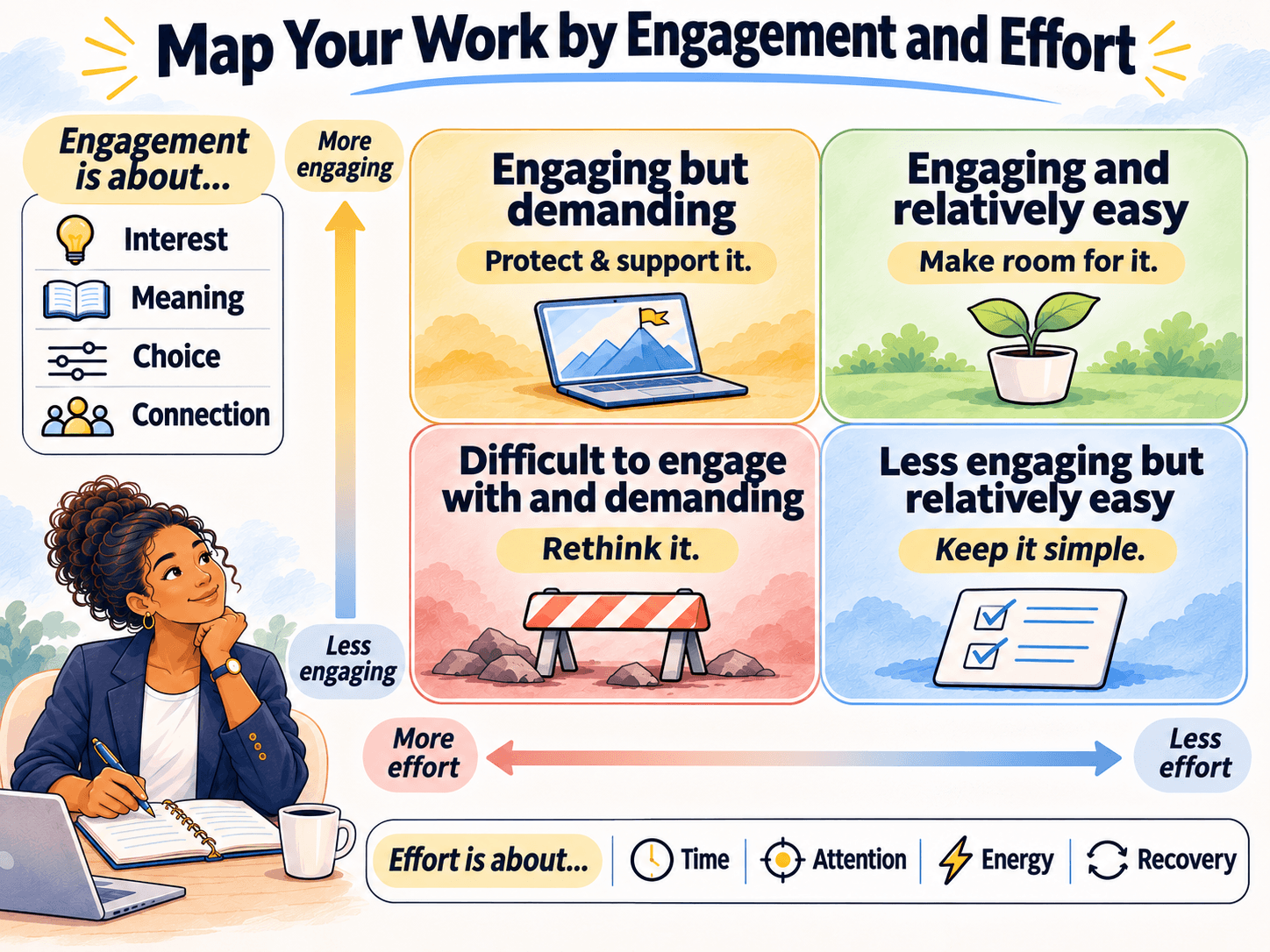
The upper-right area is often appealing. Work there feels engaging without requiring an enormous amount of effort.
Naturally, we might want more of our activities to feel that way.
But the other areas are important, too. Each suggests a different question about how we spend our time and what might make that work easier.
Protect Engaging Work That Takes a Lot Out of You
Maybe you love leading challenging projects or solving complicated problems.
You can get deeply absorbed in the work. It’s interesting, satisfying, and something you genuinely want to do.
But it also takes a lot out of you.
The goal may be to protect that work while reducing competing demands, getting support, or making more room for recovery.
Something can be deeply engaging and still become unsustainable if you’re constantly pushing past your capacity.
Make Room for Engaging Work That Feels Easier
Other activities feel interesting, rewarding, or meaningful without taking an enormous amount of effort.
These are worth noticing.
Perhaps you enjoy collaborating with a particular colleague, mentoring someone, or working through a familiar kind of problem.
If those activities also contribute to something important, could you make more room for them?
You don’t necessarily need a better way to do that work. You may simply need more opportunities to do it.
Rethink Demanding Work That Doesn’t Engage You
Then there’s the work that takes a lot from you without offering much engagement.
Maybe it’s a recurring meeting, a complicated administrative process, or a responsibility you’ve continued carrying because you’ve always done it.
These are often good places to explore what could change.
Could you reduce the amount of work? Simplify the process? Share the responsibility?
You might also find ways to make it more engaging.
And sometimes, after looking at the situation honestly, you may decide that something no longer needs to happen at all.
Keep Less Engaging, Low-Effort Work Simple
Finally, some responsibilities aren’t especially interesting, but they don’t require much effort.
That’s perfectly fine.
If a routine works well enough, there may be no reason to change it.
Although here’s something worth remembering.
A task that looks easy from the outside might require considerable effort just to get started.
That two-minute email you’ve been avoiding for three days? You might discover that it’s more demanding for you than its estimated completion time suggests.
Place activities on the matrix according to your actual experience, rather than how difficult someone thinks they should be.
And before we get carried away with our lovely little matrix, there’s one important point.
Where something falls doesn’t tell you how important it is.
Caring for a family member might be demanding and exhausting while still being deeply meaningful. An enjoyable activity might be easy to engage with but less important than other commitments.
The matrix helps us understand our experience and notice possibilities.
We still have to decide what matters and what we’re willing or able to change.
Notice Where Your Time and Energy Go
And now I’d like you to zoom out a little. Rather than focusing on one task, think about the different kinds of work that fill your week.
Maybe you spend your time solving problems, attending meetings, coordinating projects, handling messages, and keeping up with administrative responsibilities.
Which activities naturally engage you?
Which ones take the most out of you?
And perhaps more importantly, where are you spending most of your time and energy?

Imagine discovering that the work you find most interesting occupies only a small part of your week.
Meanwhile, responsibilities that require considerable effort but offer very little engagement fill most of your schedule.
That might explain something about why your workweek feels so exhausting.
You could be working hard, accomplishing important things, and still spending most of your energy on activities that feel draining or difficult to approach.
Of course, noticing the pattern doesn’t mean you can immediately change everything. You may have responsibilities, deadlines, or circumstances that limit your choices.
But it gives you a place to begin.
Instead of treating every activity as something you simply need to get better at doing, you can start considering what deserves more room, what needs better support, and what might need to change.
Choose What to Make Easier First
You don’t need to turn this into a major assessment.
Think about a few kinds of work that regularly show up in your week. Place them roughly on the matrix, based on your own experience.
Then choose one you’d like to change.
It might be a responsibility that leaves you exhausted, an activity you keep putting off, or work you genuinely enjoy but rarely have time for.
Start with our two questions.
Ask What Would Make It More Engaging
Think about what has helped you connect with similar work before.
Perhaps you could link the activity to something you care about, introduce an interesting challenge, or give yourself more choice in how you approach it.
Working with someone else might help. Or maybe you’d rather have a quieter environment where you can concentrate on your own.
There’s no single ingredient that makes work engaging for everyone. The useful question is what might make this kind of work easier for you to approach.
Ask What Would Make It Less Demanding
Now look at the work itself and everything surrounding it.
Could you simplify the outcome, remove unnecessary steps, or use a skill or tool that makes the process easier?
Perhaps someone else can help. Maybe the work needs to happen less often, or you need more recovery time afterward.
And don’t forget that doing less can be a perfectly reasonable answer.
You may even find a change that helps with both questions.
Imagine a recurring meeting that feels tedious and leaves you drained. Shortening it could reduce the effort. Changing the agenda so you spend more time solving an interesting problem might make it more engaging.
If neither change is possible, that tells you something useful, too. Perhaps you need support, an adjustment elsewhere in your week, or a conversation about expectations.
The point is to explore what can change instead of assuming you have to keep managing the same work in the same way.
Try one adjustment and see what happens.
Was the work easier to approach? Did it take less out of you? Was the experience more satisfying?
Those answers can help you decide what to keep, change, or try next.
Keep Adjusting as Your Life Changes
There’s something I’ve noticed about the tools and systems people bring into coaching.
Often, they really did work.
That planner helped. The routine made mornings easier. A particular approach helped someone stay organized for months.
Then something changed.
Their responsibilities grew. Their schedule shifted. The system required more attention than they had available. Or the initial excitement simply wore off.
A way of working that helped you before may need to change as your life changes.
The Engagement × Effort Matrix gives us another way to explore those changes without assuming we need to start over.
In How Stuff Gets Done, we looked at what it takes to move work forward. In Why Stuff Gets Stuck, we explored where that movement breaks down.
Now we’re asking another question: How can we make the work itself easier?
Maybe that means reducing the effort behind something that’s already meaningful to you.
Perhaps it’s finding a more interesting way to approach a responsibility you’ve been avoiding.
Or maybe it’s taking an honest look at how much you’re trying to do and deciding that something needs to change.
There’s no magical answer waiting for us at the end of that process.
Believe me, I wish there were.
But there are choices. Usually more than we first realize.
And when we pay attention to what engages us, what takes too much out of us, and what we’re actually able to change, we can begin creating a working life with less unnecessary struggle and more room for the things we care about.
If you’re tired of trying new systems only to end up overwhelmed again, you’re welcome to book a Clarity Call. We can talk about what’s been difficult, what you’ve already tried, and whether coaching might help you find a more workable way forward.