

One of the most confusing ways to get stuck is when nothing is technically unclear.
You know the task. The outcome matters. The deadline is real. There may even be a perfectly reasonable plan sitting in a tab you’ve been avoiding.
Still, the work isn’t moving.
Instead, you go back to the research. Open another article. Rearrange your notes. Ask ChatGPT a slightly different version of the same question.
A lot is happening around the work. The part that actually needs to get done keeps waiting.
That’s often when a work problem starts to feel personal.
If I understand this, why am I still here?
Why can’t I get myself to do something I know matters?
How many times am I going to say I’ll do this and then not follow through?
It’s easy to call that a motivation problem. But “motivation” is such a broad explanation that it doesn’t give you much to work with.
“Stuck” isn’t much better.
Three people can all say, “I can’t get this done,” while dealing with very different problems. One is buried in information. Another keeps circling between several reasonable choices. A third knows exactly what comes next and still can’t get started.
From the outside, those moments can look almost the same.
They often need very different kinds of support.
Separate knowing the task from doing the task
Understanding a task matters. It helps you see what has to happen, why it matters, and what a useful result might look like.
But knowing what to do is only one part of doing it.
The work may also ask you to sort through information, make choices, shift attention, tolerate uncertainty, begin before you feel ready, and keep going after the interesting part wears off.
And all of that happens inside a real day.
Maybe your energy is lower than usual. Your calendar is packed. Someone is waiting for an answer. Notifications keep pulling at your attention. Or the task carries more pressure than anyone looking at it from the outside can see.
None of that means you’re incapable of doing the work.
It means “I know what to do” doesn’t tell us enough.
A better question is:
What’s making this particular task hard right now?
In my work with neurodivergent professionals, follow-through often gets tangled up in one of three places:
- Information Overload: there’s too much input to sort
- Decision Overload: there are too many viable choices
- Starting or Activation Overload: the next step is clear, but getting into motion is hard
These can overlap. They can also show up one after another.
First, it helps to tell them apart.

1. Narrow the information before adding more
You started out trying to understand the problem.
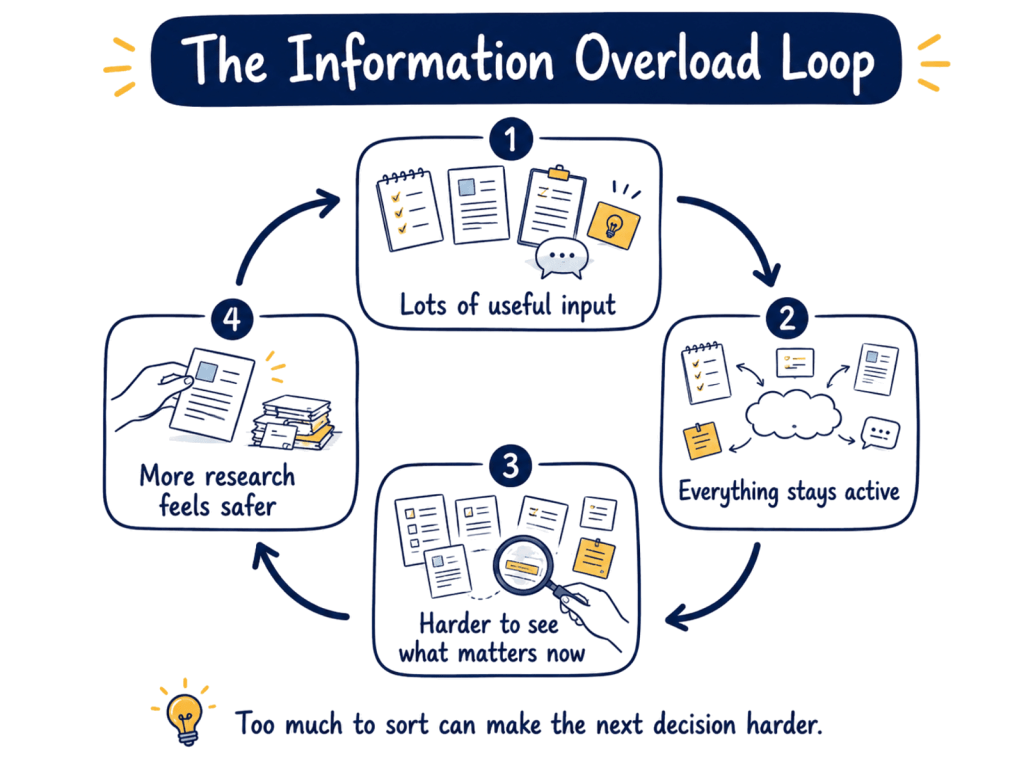
Now you have meeting notes, saved articles, three versions of the brief, comments from different people, a few videos you meant to watch, and several AI conversations offering slightly different approaches.
Some of it is clearly useful. Other pieces might be useful. Almost none of it feels completely safe to ignore.
So you keep looking.
Perhaps there’s one source that will make everything click. Someone else may have found a better approach. That important detail could still be hiding in a tab you haven’t opened.
Underneath all that research, there’s often a quieter question:
What if I’m missing something?
Curiosity isn’t the problem. Wanting to do careful work isn’t either.
The trouble starts when there’s so much input that you can’t tell what matters for the decision in front of you.
I call this Information Overload.
At that point, you may already have plenty of information. It just hasn’t been narrowed into something you can use.
More research can feel like progress because you’re active, engaged, and doing something related to the task. But each new piece of information also gives your brain one more thing to hold, compare, or rule out.
If the information itself is hard to hold or organize, a visual tool such as a mind map can sometimes help you see what belongs together and what actually matters for the next decision.
Here’s a more useful question:
What do I actually need to know for the next decision?
Not for the entire project. Not for every possible future problem.
Just the next decision.
The rest doesn’t have to be deleted or declared irrelevant. It may simply need to move out of view for now.
2. Choose what to test instead of waiting for certainty
Other times, information isn’t the problem at all.
You can already see the options.
Take the faster approach or the more thorough one. Use the flexible tool or stick with the familiar one. Keep the current plan or follow the new idea that suddenly looks more interesting.
Several choices could work.
That’s exactly what makes choosing difficult.
You head in one direction, then notice what another option does better. Someone gives you advice that makes sense, but now there’s another perspective to account for. An AI tool offers ten thoughtful possibilities when what you really needed was help narrowing two.
Before long, you’re back in comparison mode.
It can feel like you need more clarity. Sometimes you do.
But there’s another possibility: you already understand the meaningful differences. What’s missing is a choice with no downside, no uncertainty, and no chance that you’ll wish you’d chosen differently.
That choice usually doesn’t exist.
I call this Decision Overload.
It often looks like revisiting the plan, creating multiple versions, asking one more person, or reopening a decision even though nothing important has changed.
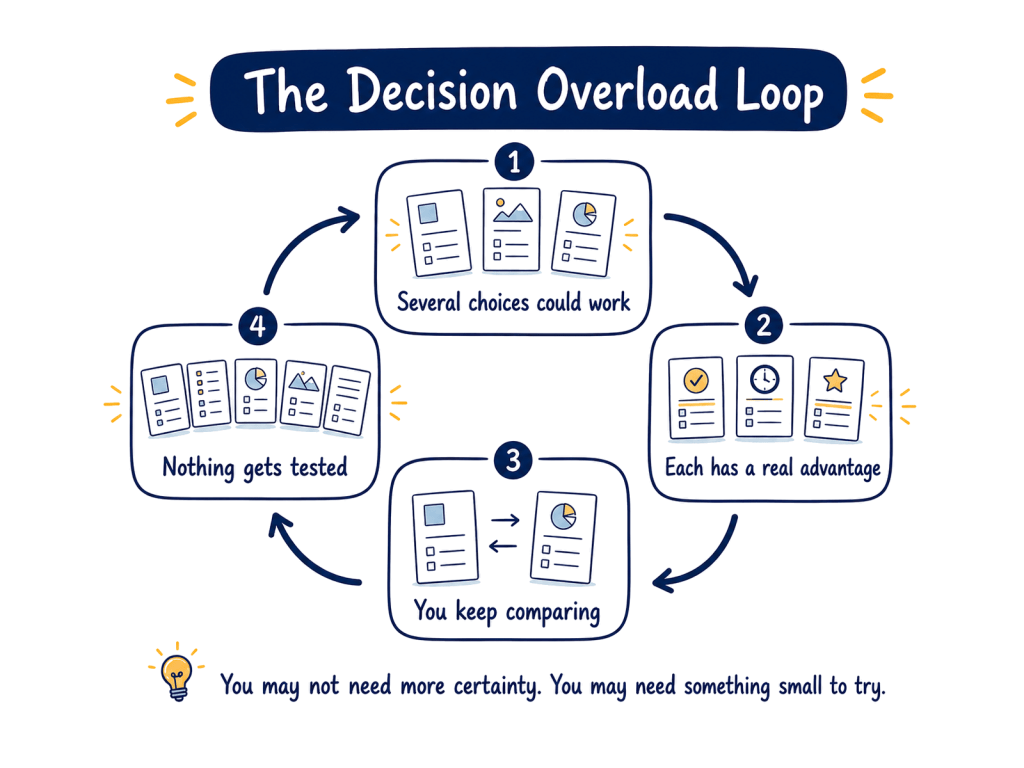
The goal here isn’t to become certain. It’s to get clear enough to move.
Try asking:
What do I need to decide today, and what can I only learn by trying something?
Thinking helps you compare.
At some point, though, the next useful information comes from contact with the work.
You send the draft. Test the tool. Try the approach for a week. Build the rough version.
Then you know something you couldn’t have figured out from another hour of comparison.
3. Lower the effort required to begin
Then there are tasks where nothing else needs to be figured out.
The email is clear. The application is ready. The first section needs editing. You know what belongs in the spreadsheet.
There may already be a template, an AI-generated draft, or a suggested reply sitting right in front of you.
And still, getting started feels strangely difficult.
Smaller messages get answered first. You check something unrelated. The workspace gets tidied up. Suddenly it seems like you need a longer stretch of uninterrupted time.
Maybe you’ll do it after lunch.
Or after the next meeting.
Or once your brain feels a little more cooperative.
From the outside, the task may look simple. Beginning it can still ask for more capacity than the visible first step suggests.
Perhaps you’re trying to shift away from something that had your full attention. For autistic and AuDHD people, autistic inertia can add another layer to the difficulty of starting, stopping, or switching activities. The task might also be boring, exposed, emotionally loaded, or difficult to do imperfectly. Your body may be tired. There may also be three hidden setup steps packed into what looked like one simple action.
Sometimes it’s just that maddening gap between I intend to do this and I am now doing it.
I call this Starting or Activation Overload.
In executive functioning terms, activation is the move from intention into action. Even a task that looks simple can carry enough emotional or cognitive weight to make getting started unusually hard. You know what you mean to do, but getting your brain and body across that starting line is taking more effort than expected.
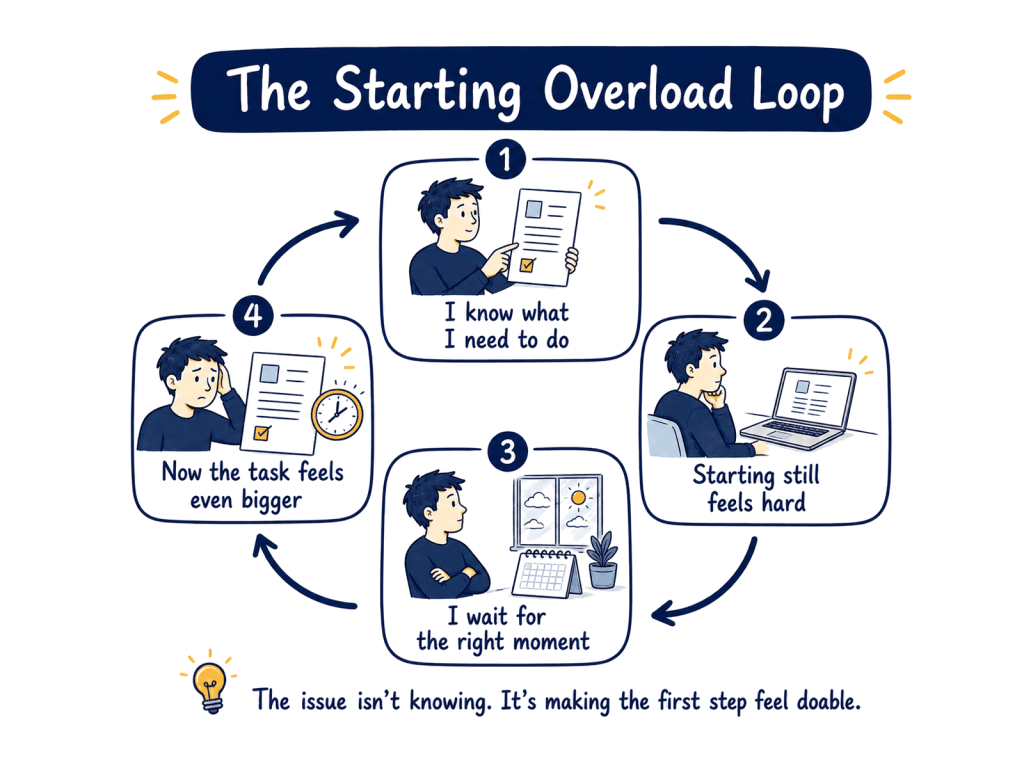
Making the task smaller can help. But “make it tiny” isn’t always enough.
A two-minute step can still feel enormous if it carries the same pressure, uncertainty, or emotional weight as the whole project.
So instead of only asking how to shrink the task, try:
What would make this easier to enter for five minutes?
That might mean lowering the standard for the first attempt. Opening only the file you need. Removing one setup step. Working beside another person. Starting with the least exposed part. Or choosing a time of day when the task asks less from you.
The whole project doesn’t have to become easy.
For now, you’re trying to make the first move more possible.
Match the support to what’s actually hard
Once you separate these experiences, something important becomes easier to see:
A strategy that helps one kind of stuck can make another kind worse.
More research adds to the pile when you’re already overloaded with information.
A bigger list of possibilities creates more work when choosing is the problem.
A detailed plan can tell you exactly what to do and still do almost nothing for activation.
Even good advice misses when it’s aimed at the wrong stuck point.
That doesn’t make the strategy useless, and it doesn’t mean you used it wrong.
The task may simply be asking something different from you than you thought.
That’s one reason the perfect planner, routine, timer, or productivity system never seems to solve follow-through once and for all.
Different tasks create different kinds of friction. Capacity changes. Deadlines change. Emotional weight changes too.
Something that helps you sort a messy pile of information may be useless when you’re afraid of choosing badly. Making a clear decision doesn’t guarantee that starting will suddenly feel easy.
Instead of asking:
What productivity tool am I supposed to use?
Try:
What’s making this particular task hard right now?
That question gives you somewhere to work from.
Locate the stuck point before reaching for a tool
Think about one thing you’ve been trying to get done.
Not your entire workload. Just one task.
Then check what kind of friction is showing up:
- Too much information: Is there more advice, research, context, or input than you can use right now?
- Too many decisions: Are you going back and forth because several options could work and you don’t want to choose the wrong one?
- Too much activation load: Is the next step already clear, but getting yourself into the task still feels hard?
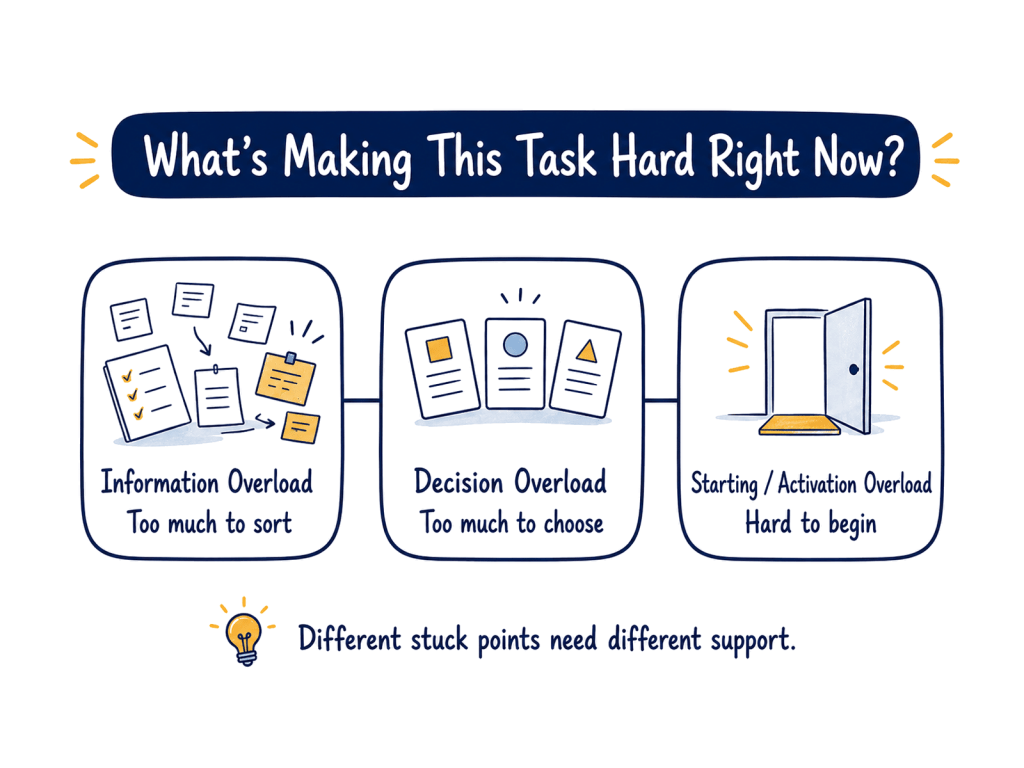
More than one can be true.
You might start with too much information. Once you narrow the pile, a decision appears. After making the decision, you may finally notice that beginning is the part asking the most from you.
These three patterns don’t explain every stuck point either.
Sometimes expectations are unclear. You may be missing authority, information, time, or cooperation from someone else. The workload itself may be unrealistic. Sensory strain, emotional stress, health changes, or low capacity can make familiar tasks much harder to access.
If work has become harder across the board, it may also be worth looking at the signs of ADHD and autistic burnout.
The point isn’t to classify yourself perfectly.
It’s to get more accurate about what’s happening before turning the moment into a story about your character.
Instead of “Why can’t I just do this?”
You have a more useful place to begin:
What is this task asking from me right now, and where is the friction?
Find the Follow-Through pattern that’s active right now
If you keep knowing what needs to happen but still can’t follow through, the two-minute Follow-Through Self-Check can help you see which of these three patterns may be most active right now.
It’s not a diagnosis, and it won’t account for every factor affecting your work.
What it can give you is a clearer starting point.
Rather than throwing another general strategy at the problem, you can try a small experiment based on what’s actually making this task hard.