ADHD and autistic burnout recovery often begins with the urge to fix everything at once.
A better plan seems like the answer.
Maybe you promise yourself you’ll go to bed earlier, catch up on the weekend, or get through this deadline and slow down afterward.
Soon, you are downloading another app, rebuilding your schedule, or writing a list long enough to organize every part of your life.
You are trying to help yourself.
Sometimes, though, the recovery plan becomes one more thing your brain has to carry.
There is another problem:
The same advice does not help at every point in burnout.
When energy is available, you may need help stopping.
As you begin to struggle, fewer demands and more support may help.
Once basic routines start falling away, you may need genuine recovery, not a more efficient way to keep performing.
So the first question is not:
“How do I get back on track?”
A more useful question is:
“Where am I in the cycle right now?”
If you’re not yet sure you’re burning out, start with the five signs of ADHD and autistic burnout.
ADHD and autistic burnout recovery depends on the phase
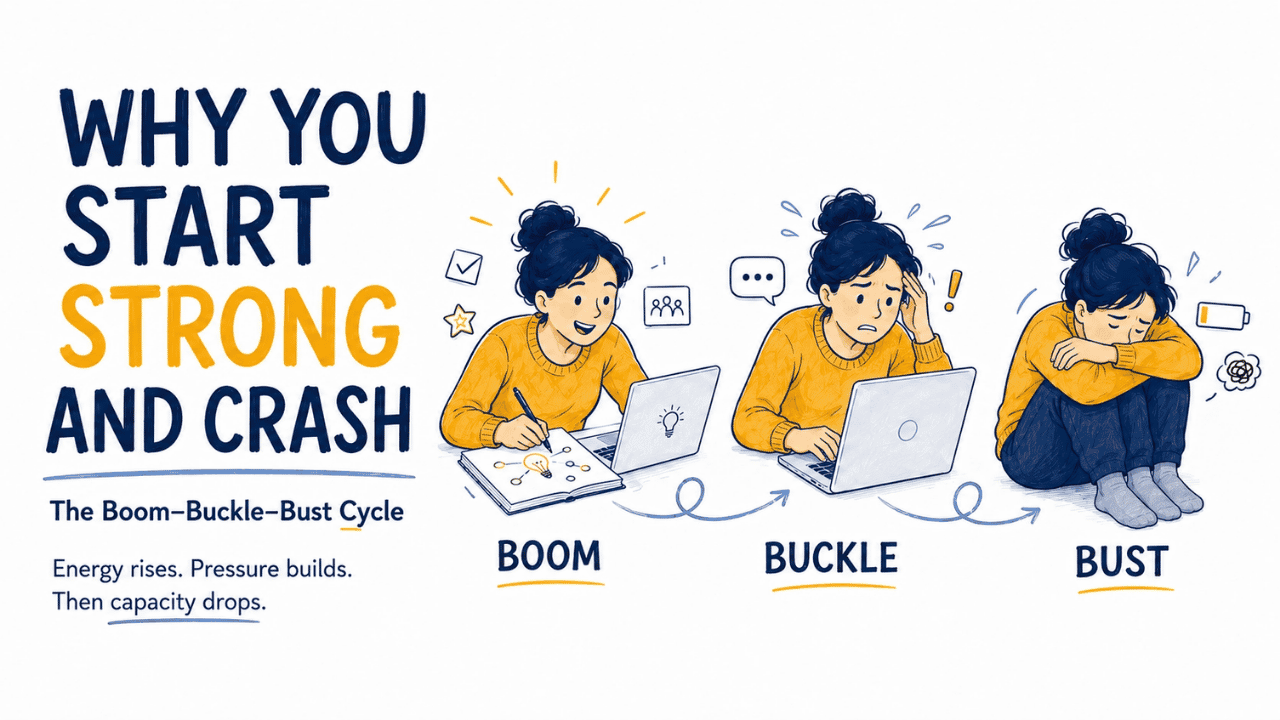
In the previous post, I introduced the Boom–Buckle–Bust Cycle:
- Boom: Energy and momentum feel available, so you do more than you can recover from.
- Buckle: You are still functioning, but starting, deciding, switching tasks, and recovering are getting harder.
- Bust: The crash becomes visible. Work, communication, routines, or basic care begin falling away.
Each phase calls for a different response:
Boom needs pacing. Buckle needs fewer demands and more support. Bust needs recovery first.
Perfectly identifying your phase is not required.
What matters is finding a useful starting point, not passing another test.

If you are in Boom: Protect tomorrow’s energy
Boom can feel like the opposite of burnout.
At first, you are focused, motivated, and finally moving.
Maybe the project is interesting, the deadline is close, or the idea feels important enough to hold your attention.
With a clear path in front of you, stopping can feel unnecessary.
The energy itself is not the problem.
What creates trouble is acting as though it has no end.
Lunch disappears because pausing might break your focus.
Late at night, you keep going because you are almost finished.
Another commitment seems manageable because today’s version of you feels fully capable of handling it.
By tomorrow, a different brain may be in charge.
What helps during Boom
Decide when you will stop before you begin.
Rather than leaving the decision to the deeply focused version of you, choose the boundary ahead of time.
Set a stopping time, an alarm, the end of a playlist, or a check-in from another person.
Stopping does not have to end your interest.
That boundary protects your ability to return.
Keep commitments smaller than your current energy suggests.
Current energy can make every future day look equally possible.
Before saying yes, ask:
“Would I still be able to handle this during an average week?”
That question makes room for the version of you who will actually have to follow through.
Your next move in Boom
Choose one thing to protect today:
- Your stopping time
- A meal
- Sleep
- A break between demanding tasks
Boom recovery is not about dimming your intensity.
The goal is to let the spark last without asking it to power your entire life.

If you are in Buckle: Reduce what is being asked of you
Buckle is harder to recognize because you are still getting things done.
On the surface, life may look mostly intact.
Underneath, nearly everything is beginning to take longer.
Messages need to be reread.
After an interruption, finding your place again takes more effort.
Even small decisions start waiting longer than they normally would.
Tension, irritability, scattered thinking, or mental fog may show up more often.
Once your usual tools stop helping, it is easy to assume you need a better tool.
A stricter schedule may seem like the solution.
Catching up can start to feel like the only acceptable next step.
By then, you may be telling yourself that slowing down is impossible until the backlog is gone.
More pressure, however, is rarely what Buckle needs.
At this stage, intervention helps more than additional pressure.
What helps during Buckle
Reduce one real demand.
Start with what is actively being asked of you, not with a complete reorganization of your life.
Instead of fixing everything, change one part of the load.
That might mean:
- Moving a deadline
- Shortening a meeting
- Reducing the scope of a project
- Delaying a nonessential decision
- Canceling something you no longer have room to carry
- Choosing a good-enough version instead of the ideal one
A better plan cannot solve a week that already asks more from you than you can realistically do and recover from.
Add support to the place where you keep getting stuck.
Support does not have to mean someone managing you.
In practice, it might look like:
- Asking someone to help you identify the first step
- Working beside another person while you begin
- Requesting written instructions instead of relying on memory
- Creating a default response for common decisions
- Taking one responsibility out of your own hands
Workplace supports can include modified schedules, flexible breaks, quieter environments, written communication, or changes to how tasks are structured. The right adjustment depends on the person, the job, and what is making the work difficult. (Job Accommodation Network)
Your next move in Buckle
Complete these two sentences:
“One thing I can pause, shrink, or renegotiate is ______.”
“One support that would make this easier is ______.”
Buckle is the point where you still have room to change the direction of the cycle.
You do not have to wait until your brain and body force the decision.

If you are in Bust: Stop trying to catch up
Bust is the visible crash.
Functioning may still be possible, but only at a much lower level.
In other cases, tasks you normally handle become almost impossible.
Cooking stops.
Messages pile up.
Words take longer to find.
Even showering, leaving the house, or making a basic decision may require more effort than you have available.
Shame often appears because you know what needs to happen.
Knowing what needs to happen does not make it possible.
At that point, the loss of control can feel frightening.
Trying to prove you are still capable may become almost irresistible.
Yet Bust is not the time to force a comeback.
Stabilizing comes first.
Research on autistic burnout describes severe exhaustion, reduced access to skills, and greater sensitivity to sensory input. People also report difficulty with speech, self-care, social connection, and everyday functioning. (PMC)
What helps during Bust
Lower the immediate demands.
Start by asking what can stop, not how to keep everything going.
Depending on your situation, you may need to cancel an appointment, request time away from work, simplify meals, delay a decision, or let someone else handle a responsibility.
One short message can be enough:
“My ability to respond is limited right now. I received your message and will follow up when I can.”
A perfect explanation is not necessary while you are depleted.
Make the day easier to survive.
A minimum viable day may include:
- Eating something accessible
- Drinking water
- Taking medication
- Sending one necessary message
- Reducing noise, light, or conversation
- Resting without turning rest into a reward you must earn
This is not your new standard.
For now, it is a temporary floor.
Let another person know what is happening.
Tell someone safe that your functioning has changed.
That person may be able to help with food, transportation, communication, household tasks, healthcare, or requesting changes at work.
Needing practical support during a crash does not erase your independence.
Instead, it keeps you from spending the little energy you have pretending you do not need anything.
Your next move in Bust
Do two things:
- Lower one demand.
- Tell one safe person.
For now, that is enough.

Do not test your recovery by returning to full speed
A better day can feel like proof that you are finally back.
More energy may be available when you wake up.
A few messages get answered, and part of the backlog starts to clear.
Relief rushes in.
The instinct is to make up for lost time.
Sometimes, the crash returns soon after.
That better day was real, but it was not necessarily proof that recovery was complete.
More likely, you had a little extra room.
Use some of that room to rebuild slowly instead of spending all of it at once.
Try adding one task back.
Attend one meeting, not five.
Work for a shorter period, then notice what happens afterward.
Recovery is not only about whether you can complete the activity.
Equally important is whether you can recover from it without losing the rest of the day or week.

Burnout recovery is not a return to the old pace
Wanting your old life back is natural.
Yet the old pace may have depended on adrenaline, masking, skipped needs, or constant over-functioning.
Returning to it may bring you back to the same cycle.
Recovery gives you a chance to ask different questions:
- Which demands repeatedly cost more than they appear to?
- What becomes difficult first when I am running out of room?
- Which support makes the work easier to begin or return to?
- What do I need to protect before I feel desperate for it?
- Could I build a pace I do not have to recover from?
You are not trying to become someone who never gets tired, loses momentum, or needs to step back.
Instead, you are learning to recognize the signs sooner and respond without treating yourself as the problem.
When additional support matters
Burnout language can describe several overlapping experiences.
The World Health Organization classifies occupational burnout as a work-related phenomenon, not a medical condition. Autistic burnout is a developing area of research rather than a formal diagnosis. (World Health Organization)
Consider speaking with a qualified healthcare or mental-health professional when exhaustion is persistent, worsening, or interfering with sleep, eating, hygiene, work, communication, relationships, or basic daily care.
A professional can also help when you are unsure whether burnout, depression, anxiety, a sleep problem, medication, or another health concern is contributing to what you are experiencing.
Seek urgent local help when you feel unsafe or are thinking about harming yourself.
Start where you are
A full burnout recovery plan does not have to happen today.
What you need is the next move that matches where you are.
In Boom, create an edge around the energy.
During Buckle, reduce one demand and add one support.
Once Bust arrives, stop trying to catch up and make the day safer.
Recovery does not begin when you become productive again.
Instead, it begins when you stop asking your brain and body to prove they can survive the same conditions that wore them down.
The goal is not to bounce back.
It is to build forward into a way of living you do not have to keep recovering from.
This is Part 3 of a 3-part series — see Part 1: the 5 signs and Part 2: the Boom–Buckle–Bust Cycle